Lighting | 3D Printing
Canelè Lamp
COMPANY
Personal
ROLE
Product Designer

Brief
While browsing lighting websites for another UX Design work, I noticed a recurring pattern: many lamps celebrate the beauty of their outer shell, while the functional components inside remain hidden. Heat sinks, structural elements and cooling systems are treated as something to conceal.
This project started from a simple question: what if those technical elements became part of the aesthetic language instead?
Revealing the invisible
Heat dissipation structures naturally generate repetitive fins and parallel lines. They're everywhere, from engines to computer hardware, and have become an iconic visual language of engineering.
Rather than hide them, I wanted to reinterpret them as a design opportunity.
The challenge was to soften this inherently technical aesthetic, transforming it into something warm, approachable and domestic. The lamp shouldn't feel like a machine, even if it proudly exposes the technical part behind it.

Revealing the invisible
Heat dissipation structures naturally generate repetitive fins and parallel lines. They're everywhere, from engines to computer hardware, and have become an iconic visual language of engineering.
Rather than hide them, I wanted to reinterpret them as a design opportunity.
The challenge was to soften this inherently technical aesthetic, transforming it into something warm, approachable and domestic. The lamp shouldn't feel like a machine, even if it proudly exposes the technical part behind it.
Revealing the invisible
Heat dissipation structures naturally generate repetitive fins and parallel lines. They're everywhere, from engines to computer hardware, and have become an iconic visual language of engineering.
Rather than hide them, I wanted to reinterpret them as a design opportunity.
The challenge was to soften this inherently technical aesthetic, transforming it into something warm, approachable and domestic. The lamp shouldn't feel like a machine, even if it proudly exposes the technical part behind it.
Designing around constraints
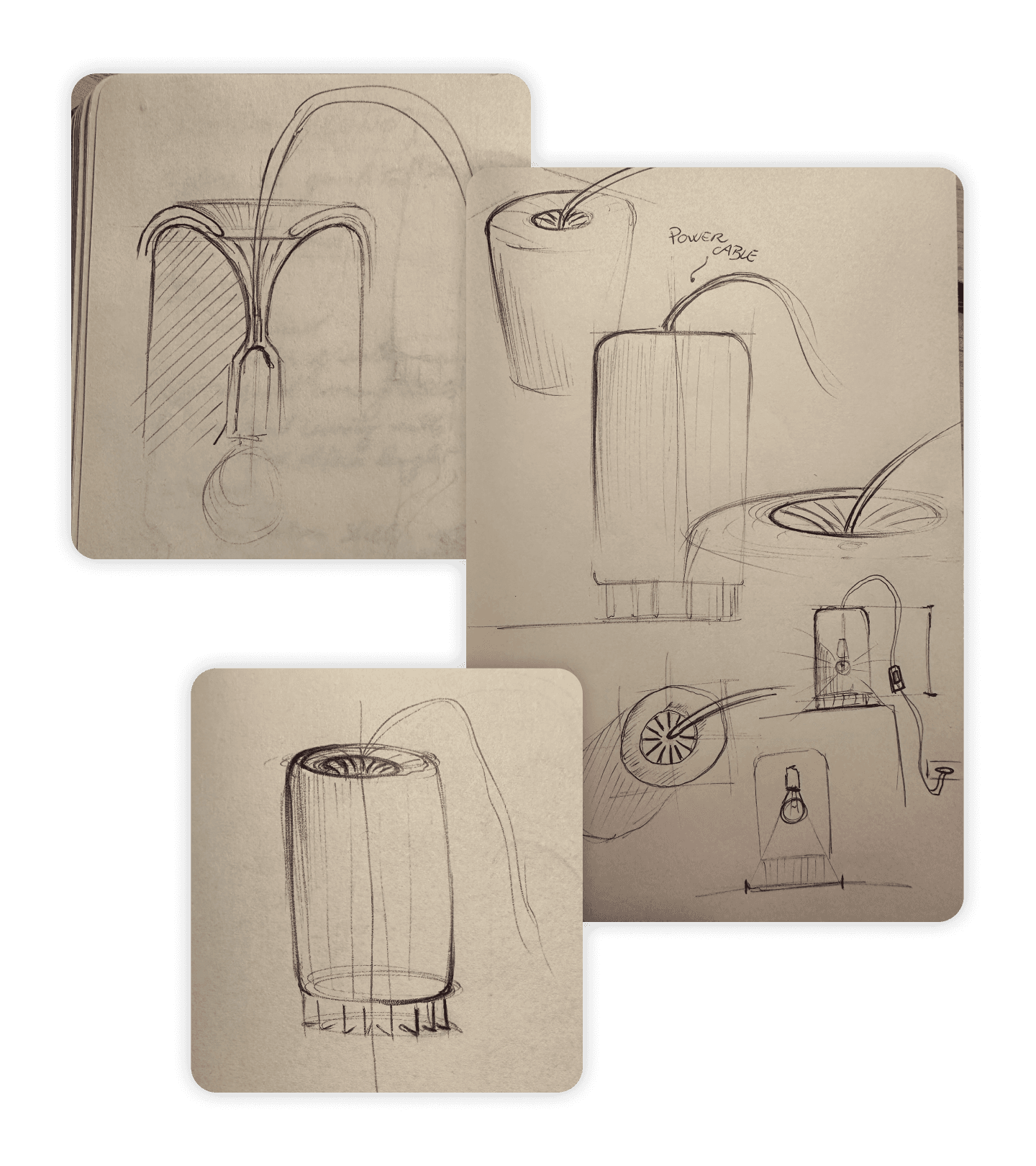
The first prototypes explored how this language could adapt to different forms while keeping the heat structure visible.
One unexpected discovery came from the material itself. The structure is 3D printed in wood-filled filament, chosen initially for its natural colour and tactile quality. When gently heated by the light source, however, it releases a subtle woody scent, adding an unexpected sensory layer to the experience.

Designing around constraints
The first prototypes explored how this language could adapt to different forms while keeping the heat structure visible.
One unexpected discovery came from the material itself. The structure is 3D printed in wood-filled filament, chosen initially for its natural colour and tactile quality. When gently heated by the light source, however, it releases a subtle woody scent, adding an unexpected sensory layer to the experience.
Designing around constraints
The first prototypes explored how this language could adapt to different forms while keeping the heat structure visible.
One unexpected discovery came from the material itself. The structure is 3D printed in wood-filled filament, chosen initially for its natural colour and tactile quality. When gently heated by the light source, however, it releases a subtle woody scent, adding an unexpected sensory layer to the experience.
Giving value to the cable
Some lamps try to hide their power cable. Here, the cable becomes part of the composition.
The cord naturally bends into the top opening, where the rounded heat sink welcomes it instead of concealing it. The result is a silhouette that feels soft, balancing the precision of the cooling fins with a warmer character.
Giving value to the cable
Some lamps try to hide their power cable. Here, the cable becomes part of the composition.
The cord naturally bends into the top opening, where the rounded heat sink welcomes it instead of concealing it. The result is a silhouette that feels soft, balancing the precision of the cooling fins with a warmer character.
Giving value to the cable
Some lamps try to hide their power cable. Here, the cable becomes part of the composition.
The cord naturally bends into the top opening, where the rounded heat sink welcomes it instead of concealing it. The result is a silhouette that feels soft, balancing the precision of the cooling fins with a warmer character.

Joint and 3D model
Keeping the lamp upside down introduced another challenge. The light bulb needed to remain easily replaceable, without sacrificing stability. This led to the design of a snap-fit joint that provides a satisfying click, both audible and tactile, making assembly part of the experience.
Joint and 3D model
Keeping the lamp upside down introduced another challenge. The light bulb needed to remain easily replaceable, without sacrificing stability. This led to the design of a snap-fit joint that provides a satisfying click, both audible and tactile, making assembly part of the experience.
Joint and 3D model
Keeping the lamp upside down introduced another challenge. The light bulb needed to remain easily replaceable, without sacrificing stability. This led to the design of a snap-fit joint that provides a satisfying click, both audible and tactile, making assembly part of the experience.

The final object
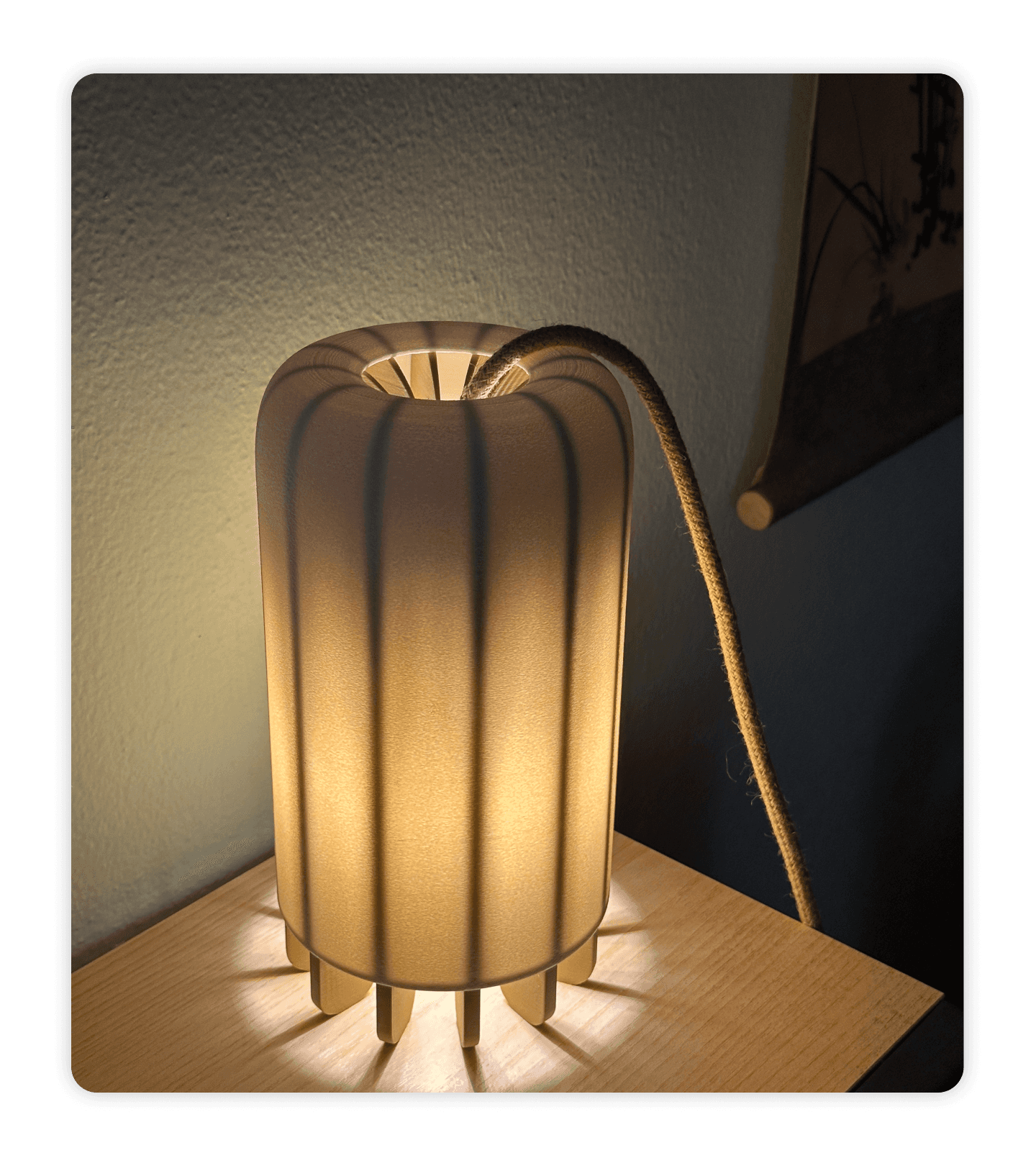
The heat sink remains visible through the top opening whenever the lamp is switched on, revealing the technology that makes the object work.
On the bottom, the same structure becomes a set of small feet that slightly lift the lamp from the surface, improving airflow while subtly humanising its appearance.
Instead of hiding its functional components, the lamp celebrates them.
The final object
The heat sink remains visible through the top opening whenever the lamp is switched on, revealing the technology that makes the object work.
On the bottom, the same structure becomes a set of small feet that slightly lift the lamp from the surface, improving airflow while subtly humanising its appearance.
Instead of hiding its functional components, the lamp celebrates them.
The final object
The heat sink remains visible through the top opening whenever the lamp is switched on, revealing the technology that makes the object work.
On the bottom, the same structure becomes a set of small feet that slightly lift the lamp from the surface, improving airflow while subtly humanising its appearance.
Instead of hiding its functional components, the lamp celebrates them.
Why Canelè
Showing prototypes to people became part of the design process.
Rather than asking whether they liked the lamp, I asked what it reminded them of.
The answers were surprisingly consistent.
Some saw a French pastry. Others imagined a cocktail with a straw. Someone else described it as a little alien with a curious antenna.
The first association became its name:
Canelè.

Why Canelè
Showing prototypes to people became part of the design process.
Rather than asking whether they liked the lamp, I asked what it reminded them of.
The answers were surprisingly consistent.
Some saw a French pastry. Others imagined a cocktail with a straw. Someone else described it as a little alien with a curious antenna.
The first association became its name:
Canelè.
Why Canelè
Showing prototypes to people became part of the design process.
Rather than asking whether they liked the lamp, I asked what it reminded them of.
The answers were surprisingly consistent.
Some saw a French pastry. Others imagined a cocktail with a straw. Someone else described it as a little alien with a curious antenna.
The first association became its name:
Canelè.
Follow me on other channels
Follow me on other channels
Follow me on other channels